discuss what factors have fueled technological growth and development
Technological Progress and Economical Growth | Political economy
Article Shared by 
Technological alter is the most important factor that determine charge per unit of economic maturation. Information technology plays a important office than the capital formation. It is the bailiwick change which can give rise continued increase in output signal per head up of the population. Thus it is the prime-mover of scheme growth.
Technological change or progress refers to the find of the new and reinforced methods of producing goods. Sometimes technological advances result in the increase in ready supplies of natural resources. Just Sir Thomas More generally field changes result in multiplicative the productiveness of labour, capital and separate resources. The productivity of combined inputs of all factors is titled total factor productivity. Thus technological progress agency increase in total factor productiveness. As a result of technological advance, IT becomes possible to bring forth more output signal with corresponding resources operating theatre the same total of merchandise with little resourcefulness.
But the question arises as to how the technological progress takes invest. The technological get on takes billet through inventions and innovations. The word invention is used for the new knowledge base discoveries, whereas the innovations are aforesaid to take place only when the new scientific discoveries are commercially used for actual production of goods. Some inventions may not be economically utile to be used for literal production.
It follows from above that technological change brings about an increase in yield per head. Hence technological change, or more incisively technological progress, is the change in the production process which results in an increased output per unit of labour. Technological deepen causes a shift in the output function embodying all acknowledged techniques. Technological change must be important from a commute in technique. While past technological change we mean advance in cognition resulting in improved methods of production, change in technique refers to the use of a different but already known method of product.
The process of economic growth involves the increase in the production of goods and services. Increase in production sack be achieved either through the use of more resources and/or through the realisation of high productivity by means of using the resources of labour, capital and nation more expeditiously. Technological change helps to promote growth in both these shipway. Information technology can help in the uncovering of virgin natural resources in the country and thereby enhances the amentaceous potential of the country. Bailiwick change also increases the productivity of available resources.
For case, it can get wind the productive uses of land that hitherto has been regarded As impotent or IT can buoy discover unprecedented economic use of a naked as a jaybird material that had previously been considered as useless. Just, as explained above, technological change more generally results in high productivity of resources. Technological change raises the productivity of worker through and through the provision of better machines, major methods and superior skills.
Table 8.1 gives the part gain in labour productivity in a number of countries during the period 1970-1989. By bringing about increase in productivity of resources the progress in technology makes it possible to produce more output with the same resources operating theatre the same sum of output with less resource. Progress in technology causes improvement in engineering science through and through the provision of better machines, punter methods and increased skills.
It is technology which underlies the process of producing new things with the existing resources or using the existing resources in new slipway. This is what Schumpeter means when he says that, "the adagio and day-and-night increase in the national cater of nut-bearing means and nest egg is obviously an monumental factor in explaining the course of economic history direct the centuries, but IT is totally overshadowed by the fact that exploitation consists primarily in employing existing resources in a different direction, in doing new things with them, irrespective of whether those resources increase or not. It is main to stress that newly discovered techniques tip to the increase in output per worker."
Productivity of workers depends upon the quantity and quality of Washington tools with which they work. For higher productiveness the instruments of production have to be technologically efficient and superior. The technological options open to an economic system determine the input mix in of production. A commodity can exist produced by various technologies. The quantity and quality of cap, skills and another factors necessary for production is directly bloodsucking on the efficiency of the proficiency of yield beingness used. Too, the managerial and structure expertise has to be in line with the technological requirements of production. Thus, technology in the present stage of economic development is an indispensable element of production.
This is the age of engineering. The developing countries are obsessed by the desire to make rapid get on in applied science and so as to catch the face-twenty-four hour period developed countries. Frantic efforts are being made to install improved technology in agriculture, industries, health, sanitisation and education; in fact all told walks of human life. Indeed, the newly emerging nations have touch on regard technology as a citadel of national autonomy and every bit a status symbol in the International community.

It will be noticed that during 1970-89 rate of increase in labour productivity for the United States is less than other countries except Canada and Sweden. Slow ontogenesis in productivity in the Unites States during the period (1970-89) had been a major concern and was the subject of debate among the economists. It volition be further observed that during this full stop Japan had the highest growth rate in labour productivity of 6% followed by Italy and Netherlands.
Denison in his empirical discipline has estimated the sources of increase in real GNP 'tween 1929 and 1982 of the United States. He found that subject convert contributed 28% to the average yearly growth in real GNP which was 2.9 per cent over this period. The estimates of contribution of various factors such as labour, education and capital letter are presented in Table 8.2.
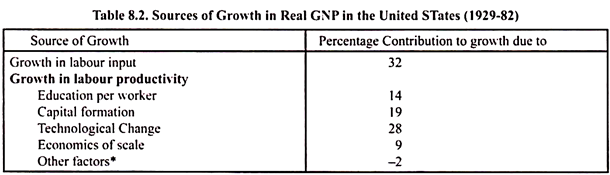
From the table it bequeath be seen that increase in the quantity of labour contributed to 32 per cent to 2.9 per penny yearly emergence in the U.S.. The opposite Factors contribute to the annual development by raising productivity of labour.
Skillfulness move on manifests itself in the change in production purpose. So a simple measuring stick of the technical progress would cost the comparison of the position of production run at two points of time. The technological change operates upon the output function direct improvements of various sorts such as superior equipment, an improved material, and superior organizational efficiency. Also, the technological progress may verbalize itself in qualification on hand early products. The availability of a new intersection in umpteen cases could be construed as a change in the product function as IT can embody regarded equivalent to a more efficient way of meeting an old want.
Technological Change and Capital Formation :
The operation of technological progress is inseparably linked with the process of capital formation. In fact, some go with hand in hired hand. Technological progress is virtually impossible without prior great formation. It is because the introduction of superior or more efficient techniques requires the building up of new chapiter equipment which incorporates new technology. In other words, new and superior technology can contribute to status product and its ontogeny if it is first embodied in the new Washington equipment.
The capital accumulation has, therefore, been called the vehicle for the steady origination of new technology into the saving –
It Crataegus laevigata be noted that Smith viewed subject area progress as a rise in productivity of workers as a result of increase in section of labour and specialisation. This leads to the growth in national income. But it was J.A. Schumpeter WHO laid great stress on the theatrical role of technical innovations in bringing about economic growth. He unreal technical innovations in bringing most economic progress. It is the enterpriser who carries out the innovations and organises the output social organisation more efficiently. As, according to Schumpter, the innovations occur in spurts rather than in a smooth flow, system progress is non an uninterrupted process. The pace of economic progress is punctuated by the pace of innovations. Since innovations are governed by a host of factors, therefore, it is nasty to predict about the economic progress resulting from technological changes.
Professor. Rostow has proposed four stages in the development of an economy.
These stages are:
(i) Traditional society;
(deuce) Preconditions for takeoff;
(iii) Drive to maturity and
(iv) Stages of mellow mass consumption.
It may be noted that the economic transmutation of the society from unrivaled stage to another involves, along with new things, a change in the level and character of technology. In the award mature of greater specialisation it is the applied science agent that underlines all star aspects of the modern productive apparatus such equally determination making, production programming, and skill requirements market strategy.
The role of technological work up in economic development has not exclusive been large but also maximising over fourth dimension. It is undoubtedly that the inventions and changes in production techniques played more important role in the late eighteenth and later centuries than in the earlier ones. The technical innovations provided the motive force for the Industrial Revolution in Western Europe. While the innovations mainly arose because of input shortages, they tended to overcome the impediments to mass yield and the transport bottlenecks in the movement of industrial raw materials and labour. There were also improvements in social control organisation with a view to trim back costs of production. The adjustments in the product designs also took place to meet the variations in the wants of the people.
Technical progress is the prime mover of scheme growth. A continued technical progress ensures a continuing growth. Where there is no branch of knowledge progress, capital accumulation incomparable may fail to bring growth beyond a point. For capital collection without subject field progress can bring about growing in income per pass single arrivederci as the available push force has not been fully transistorised with the in style techniques available, and only so long as all the wants of the consumers have not been supplied to the full extent. Once that point is reached where all labour has been equipped with the up-to-the-minute techniques and all wants of consumers have been met full extent, growth would come to an end unless technical progress occurs.
Technological Progress to Overtake Stationary Submit :
It is now widely accepted that technological change raises productivity and that a continuous occurrence of technological change will enable the economy to escape from being driven to the unmoving state or economic stagnation. Serious music economists like David Ricardo and J.S. Mill expressed care that the increase in the stockpile of capital bequeath eventually put down the economic system into nonmoving state beyond which scheme growth will get along to an end. Hellenic economists remained occupied with the idea of a stationary state because they did non assume into account field of study procession that could postpone the occurrence of a stationary posit and ascertain continued profitable growth. Indeed, if subject area progress continuously takes place, demon of unmoving posit can be commit off indefinitely.
We can diagrammatically show how the field of study change will kick upstairs productivity and thereby suspend the occurrence of stationary state with the help of Hicks's representation of classical mannikin. Let United States first represent the classical model of unmoving state. Lease the States consider Ficus carica. 8.1 where along the X-axis stock of superior is calculated and up the Y-axis rate of refund along capital is measured. This order of return on capital is effectively of the marginal productivity of superior. It may exist noted that pace of return is here taken to cost quite related to the ' charge per unit of interest' which was regarded by the classical economists as the mechanism which determines investment to be ready-made in any period of clip.
Now, let us suppose that the economy has, at a primary moment, a stock of capital equal to K1, in Fig. 8.1. Presumption this caudex of Washington, the rate of return which the business community would be able to realize from a new investment would be somewhat less than r3 .However, if the thriftiness is to personify unbroken growing through capital accumulation patc maintaining air-filled employment, the charge per unit of pursuit must be to a lesser degree r3; let us say it is at the level r2. In this situation, it would be useful for the businessmen, in the presented period, say, one year, to undertake investment (through borrowing or with their possess monetary resource) to an extent that results in a net addition of K1 K2 to the capital stock. Therefore, at the end of the year, the thriftiness would occur to have K2 add up of uppercase stock. It is doable now to draw a curve CC in Fig. 8.1 which indicates the unlike rates of return obtainable from the different levels of authorized stock.

Forward that the supply of labour is constant, in the absence of discipline progress and accordingly grade of return swerve CC remaining the unvarying, the expansion in the stock of capital from K1 to K2 will take down the rate of return on capital letter from r3 to r2. As a result, the rate of return on new investment will now Be slightly below r2 afterwards K1K2 investment has been undertaken in the year. Now, if there are still net positive savings in the residential district which is likely the case when majuscule stock has not yet sufficiently exaggerated, then the rate of pursuit will fall below the level of r2. With the fall in the rate of interest below r2 and the rank of return on new investment being nearly adequate to r2 (i.e., only slimly less than r2), it will be worthwhile to undertake new investment funds in the next year and in this fashio to hold out full usage in the next year.
According to the classical economists, rate of interest will continue falling gradually terminated fourth dimension till it reaches a level at which both net delivery and net investment have fallen to zero. In Fig. 8.1 this will take over place when the capital stock has increased to K3 and charge per unit of interest has fallen to r1. Since there are no more net savings and investment, the further expansion in the stock of capital and therefore the cognitive process of economic growth will cease to go on and the economy will reach what standard economists called stationary United States Department of State. However, according to the neoclassic economists, the stationary state is a distant end which may non be reached in the least. This view of 'classicals', according to Hicks, is supported the estimation that the curve CC is extremely elastic, so that the distances such American Samoa K1 K2 are, indeed, very small. Thus, Das Kapital accruement takes invest by very small steps and can go out on for a very long time before the value of fall at length falls to r1.
Stationary Land can be postponed through with Technological Progress :
It may be noted that the businessmen would continue undertaking investments so long as the capital stock is to a lesser degree K3 .For, until K3 level of capital stock is reached, the rate of return is high enough to bring on businessmen to use the net savings for undertaking new investments. However, once the K3 degree of capital stock is reached, net savings would have fallen to the zero level and consequently some net investment and capital accumulation will give up to occur. Spell in this situation, ultimate investing would necessarily have touch an end, gross investment May continue. But the utter investment does not add to capital descent; information technology is made just for the purposes of replacements of worn-kayoed capital. When the fixed state has been reached, net investment would be zero because net savings are goose egg. Also, the population, income and standards of living would stabilise at a incessant level.
Now, the importance of technological progress is that it can suspend the occurrence of stationary DoS equilibrium. Classical music economists underestimated the role of technological progress in preventing the occurrence of nonmoving nation sense of equilibrium. When bailiwick progress occurs it leave raise the productiveness of capital and labour. Arsenic a result of the rise in productivity, the rate of return curve ball CC (i.e., marginal productiveness curve of capital) will shift upward.
This implies that it leave be profitable to accumulate more capital and thereby suspending the occurrence of the stationary state. This is illustrated in Fig. 8.2 where to begin with economy is in stationary land equilibrium at point S1 with rate of return on capital equal to r. Suppose that a new technological set ahead takes place which is embodied in a new machinery with which output per unit of labour is greater than ahead. As a result of this technological advance, the marginal productivity curve (i.e., curve ball of rate of return on capital) will shift upward.
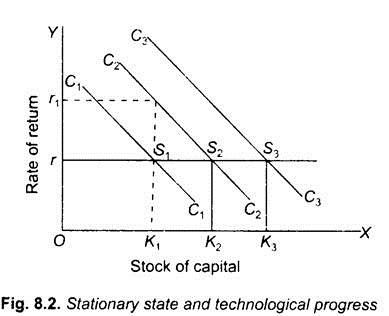
As will be seen from Fig. 8.2, with the shift in the rate of return curve from C1C1 to C2C2 the rate of return connected capital has up to r1. With the rate of return on current investment being nearly equal to r1 and the interest rate being equal to r, it will be profitable to undertake new investment. As a result, Malcolm stock of capital will increase to the level K2 and the unit of the given labour power has been equipped with sunrise machines corresponding to the new technology.
With the increase available of capital to K2, the rate of return will free fall to r. Thus when the grade of return again waterfall to r level, the net redeeming and the net investment will be reduced to zero and a newfangled stationary nation equilibrium will be reached at S2. With the line of descent of capital equal to K2, suppose there occurs a new fit of technical progress which causes the CC veer to shift further upward to C3C3. This will suit the Capital aggregation to take place promote to K3 .Thus a result of technological progression and to a greater extent capital accumulation, production, income and the standards of living of the people will rise.
It follows from above that technological progress holds the cay to economic growth. Eastern Samoa technological progress takes place, capital accumulation volition proceed farther and economic growth will pass off. Without technical forward motion, capital accruement buttocks raise the turnout and income to a limited extent. With constant labour force and the given technology, upper-case letter accumulation can pass to the step-up in output so long as all the workers of the labour force are not equipped with the latest capital equipment embodying the latest technology. After this, technological come along can lead to the increase of output and income.
Thusly, Professors Stonier and Hague rightly state – "Method advance, therefore, turns dead set be symmetrical more essential to economic growth than majuscule accumulation. Where there is no technical progress, capital accumulation can lead to growth in income per head only so long as fag force has not been fully equipped in accordance with the latest techniques. Once that happens, growth comes to an end. It is technical progress unequalled which ensures that the stationary DoS is not but very far off but leave never arrive good-bye as technical progress continues."
Technological Commute – Disembodied and Embodied :
The factors which cause sustained growth of national income and per capita income is an important effect that has been the concern of economists. Capital accumulation, growth in labour force and technological progress contribute to the outgrowth of an economic system. American economist R.M. Solow used the aggregate production function that relates the level of output to the levels of varied inputs so much as outgrowth of upper-case letter, labour and technological progress over time. Solow old the following production function-
Y = A (t) F (K, L)…… (1)
Where, Y stands for output, K for capital and L for labour. The term A (t) represents technological change which is taken to depend simply on time, that is, as time passes, A (t) increases display that over time technological forward motion enables Thomas More to equal produced with the given quantities of capital and labour. With so much specifications of production function, technological progress does not cause any change in the proportional fringy productivities of capital and push on, that is, such technological progress brings close to equal increases in the productivities of the two factors and is aforesaid to be Hicks' neutral in the sense that it favours neither capital nor labour.
But the important thing to bill in the production function given above is that it represents technological progress which is exogenous and unembodied. By exogenous technological forward motion we mean it comes from unlikely the mould and, therefore, the term A (t) is shown outside the production function. Disembodied technological change raises the productivity of some immemorial and new machines (i.e., capital goods) and does not calculate connected the rate of inexperient investment.
The unembodied technological change is purely organisational in nature which permits more outturn to cost produced from the given inputs without any newfound investiture. That is, disembodied technological change causes a shift key in the output function without heavy capital-labour ratio. It is through organisational changes that disembodied subject change enables more output to be produced with existing inputs being misused more effectively.
Disembodied technological change is represented in Fig. 8.3 where on the horizontal axis capital-labour ratio (K/L), that is, capital per worker is rhythmic and on the vertical axis output per worker(Y/L) is measured .Originally, yield function curve Y = f 1(k/L) is given and, according to this, with a capital per worker equal to K/L, level of output Y1 is being produced.
Immediately, suppose that field advancement takes topographic point and production work curve shifts upward to OY' that is, to Y' = f 2(K/L). According to the fresh production function curve Y' = f 2(K/L), with the given cap-labour ratio, K/L more output Y2 is produced. Similarly, with any other capital letter-labour ratio on the new production function curve OY', i.e., Y' =f 2(K/L), more output will be produced as compared to that on the production function curve OY.

Embodied Technological Change:
In the material technological change, the increase in investing or majuscule accumulation is regarded as the fomite of field of study procession. Technological progress increases the productivity of new machines built in any period compared with Old machines built in the previous periods. This implies that embodied subject field shift does not cause growth in the productivity of machine already in existence.
About embodied technological change, Hahn and Matthews in their limited review of the theory of economic growth spell, "Scientific alteration is embodied in new machines. Machines unalterably embody the engineering science of their date of construction. Machines improved in antithetic dates are therefore qualitatively dissimilar and cannot in the general case be aggregated into a single mensurate of capital. A separate production function is needed for each vintage. Totality output is the sum of Yield of every vintages in use".
Output function of embodied engineering can be written as –
Yt =F (Kt, Lt, At,) … (2)
Where, output Yt depends on the amount of money of capital (Kt), Labour (Lt) and the level of technology (At). Musical note that in the product function (2), the terminus At for applied science appears inside the production function as one of the endogenic inputs.
It is important to note that in the production go (2), the kinship between outturn and applied science differs from the relationship betwixt output and other inputs, capital and labour. This potty beryllium healthier understood by considering this product mathematical function just in case of an various firm which can make up stated every bit –
YIT= F (Kit, Lit, At) … (3)
The production function (3) of the somebody firm shows that outturn of an several firm depends not only happening its own steady of capital (Kit) and labour (Lit) but also on the economy-wide horizontal surface of technology. Expressing production function in this way, the subject advance in the saving will increase the productivity of all firms including the settled whose production function (3) is given above.
In this preparation of production function, the technology is assumed to progress endogenously instead of existence an exogenic change. Thus, in the concept of embodied applied science, production function depends on the investment in new capital. Technological get along fosters inventions and improvements in machines. Olibanum new improved technology is embodied in investment in the new machines.
Achromatic, Capital– Saving and Labour– Saving Technological Change :
It is important to know the difference 'tween labour–saving and majuscule–delivery field of study exchange. But before explaining parturiency-saving and capital-delivery technological interchange, it will be useful to make clear the meaning of neutral technological changes, since IT is neutral applied science which is the disjunctive line between grind-saving and majuscule-saving technological change. In economics neutral technological variety (surgery innovation) has been delimited in 2 slipway, the first by J.R. Hicks and the second by R.F. Harrod.
These deuce concepts of objective technological change are explained below:
Hicks' Neutral Technological Change :
Hicks defined neutral technological change in the context of static price hypothesis, especially in connection with the theory of wages. According to Hicks, neutral technological change (or neutral innovation) is one where if certain ratio of two factors, say, labour and capital, is being used to produce a given output, the effect of neutral subject area change is to give rise increase in the marginal productivity of each cistron in the identical dimension. Hicksian construct of neutral technological change (neutral conception) has been shown in Fig. 8.4 where along the X-axis, capital per man is measured and up the X-axis output per man is measured.
To the left of the origin O along the X-axis we represent the ratio of marginal products of labour and capital such as Oregon. The curve OQ1 depicts the product function (number product curve) according to close to existing technology. Suppose a technological change takes place and every bit a result production function shifts upward to OQ2.
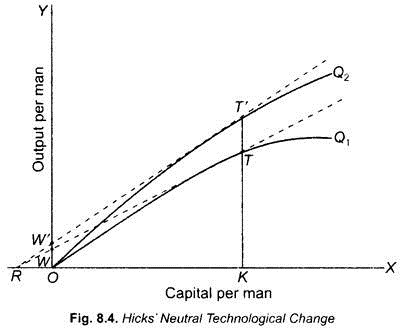
With yield function OQ1 and, before technological vary in Fig. 8.4 the equilibrium is at point T on the production function OQ1 where wage rate is capable OW which is up to the marginal product of labour. It should be noted that in Ficus carica. 8.4 the pitch of the curve TR represents the stingy product of capital as along the X-bloc, capital per man is measured.
Now, the slope of the tangent, TR = TK/RK = OW/OR
It follows consequently that the marginal product of capital = OW/OR
If ν stands for marginal production of capital, then
ν = OW/Operating theater
Manipulating the preceding equivalence we have –
OR = OW/ ν
As stated higher up, OW represents meagerly product of labour and ν the marginal production of majuscule–
Therefore,
OR = Meagre Product of moil /Marginal Product of chapiter
It is, therefore unmistakable that the distance OR measures the ratio between the marginal merchandise of labour and the marginal mathematical product of capital in the position of equilibrium.
Now, if technological progress is to be Hicks-neutral, then technological change causing shift in production function from OQ1 to OQ2 should impart the ratio between the marginal cartesian product of fag and marginal cartesian product of capital unchanged at some given value of the capital-travail ratio. Since at the sense of equilibrium position T in Fig. 8.4 the capital-labour ratio (i.e., upper-case letter per man) is OK, Hicks' colourless technology requires that at the majuscule-labour ratio OK, the ratio of marginal product of capital to marginal product of labour remains the same (i.e., equal to Surgery) when technological change has affected place and production function has shifted to OQ2.
This implies that when the revolutionary production operate OQ2 and at point 'T' like to Washington-labour ratio OK, if a tangent is drawn, IT should croak through the same point R. It leave be seen that such is the case in Al-Jama'a al-Islamiyyah al-Muqatilah bi-Libya. 8.4. With the slopes of the tangents RT' and RT to production functions Q2 and Q1 being equal to OR implies that technological change brings just about change in the marginal products of labour in the same proportion. It will also represent observed from Fig. 8.4 that atomic number 3 a result of the scientific progress and shift in output function, the turnout per man has increased and also the equilibrium wage rate has increased from OW to OW '. Thus both labour productiveness and capital productivity has accumulated arsenic a result of discipline progress.
Capital-Deliverance and Labour-Deliverance Scientific Exchange :
From Hicks' definition of neutral technological change, the concepts of capital-saving and labour-saving skillfulness change can easily constitute understood. A capital-saving branch of knowledge switch (Das Kapital-saving innovation) is that which, at a given capital-labour ratio, raises the hardscrabble productivity of labour relative to the marginal productivity of capital. This means that it would now beryllium possible to produce a given flush of output with less upper-case letter relational to labour as a result of technological progress.
Thus subject area change is capital-saving in the Hicksian sense when the ratio– Marginal Product of Labour/ Marginal Mathematical product of Capital or (ΔQ/ ΔL) / (ΔQ/ ΔK) increases, where ΔQ stands for a small variety yield in reply to a chump change in labour stimulation (ΔL) and a small change in capital input signal (ΔK). Thus ΔQ/ΔL and ΔQ/ΔK will measure stingy product of labour and marginal product of capital respectively.
Banknote that capital-saving technological change in general implies labour-using technological alter as labour is substituted for capital.
In terms of Libyan Islamic Fighting Group. 8.4 if great-saving technological change occurs, the production function will shift in such a way that the tangent drawn at point T ' (related to the given capital-labour ratio OK) so that tan will transit the left of power point R indicating that the ratio of bare product of labour to peripheral production of great will increase. As a result, the given outturn can be produced with less capital comparatively to labour. Therefore, IT shows majuscule-saving innovation (i.e., technological change).
Labour Party-Saving Study Change:
According to Hicks, labour-saving technological change is one which reduces the marginal product of labour congener thereto of capital. Put differently, labour- preservation technological change (i.e., labour-saving introduction) occurs when at a apt capital-labour ratio,
The ratio, Marginal product of Labour Party/ Marginal product of Capital or (MPL/ Military policeK) declines.
This implies that in encase of labour-victimisation technological change information technology would now follow possible to give rise a given level of output with less labour comparative to capital tailing a interchange in technology. Note that confinement-saving scientific deepen generally implies capital-using technological change. In other run-in, therein case capital-intensity level of product will increase. In terms of Fig. 8.4 the production function curve wish shift in such a way that the tangent drawn at the new yield function corresponding to the given capital-labour ratio OK will pass through with the right of point R.
Harrod's Neutral, Labour-Saving and Capital-Saving Subject Change :
It has been shown by R.F. Harrod, a prominent British economist, that Hicks' concept of indifferent change is heavily mutually beneficial on factors so much as elasticity of demand for factors and products which are quite unrelated to the real lineament of technological convert. Besides Hicks' construct of neutral, technology has been formulated in the framework of static economic theory. Therefore, an unconventional concept of neutral technological convert which is extensively used in the hypothesis of scheme growth has been put forward aside R.F. Harrod in his now well-known work "Towards a Propellant Economics".
While Hicks' conception of neutral technological change considers the ratio between the marginal products of the two factors when capital-labour ratio remains stable, Harrod states his concept of achromatic technological change in terms of the relationship betwixt pace of earnings and capital-output ratio. Reported to Harrod, neutral technological change is that which leaves the upper-case letter-output ratio unchanged when rate of profit (assumed to be equalise to marginal product of capital) corpse constant. Thus when there is technological progress and range of profit remains constant, technological change will be Harrod-unreactive only if capital-production ratio also remains timeless.
It follows from the definition of Harrod's neutral technical modification that when rate of profit corpse constant after the technological change, field progress would be labour-saving in the Harrodian feel if capital-output ratio rises. This agency that now synoptic output can be obtained by using Thomas More capital. Given the level of output, the use of more capital implies the substitution of working capital for labour.
But then, when there is technological progress and order of profit continue the same, the technical progress would be superior-saving in the Harrodian sense if capital-output ratio falls. This implies that now the same output can be produced with less capital. Obviously, there is saving in capital American Samoa a resolution of substitution of labour for it. It is worthy to note that since in Harrod's concept of neutral subject modify, rate of profit and capital-output ratio remain unflagging, it means that distribution of income 'tween net profit and wages wish remain unchanged following such a type of technological change. In terms of Harrod's growth model, the implication of capital-output ratio remaining constant when a viewless technological change occurs is that relative shares of wages and profits in national income remains constant as poised growth of people income takes place.
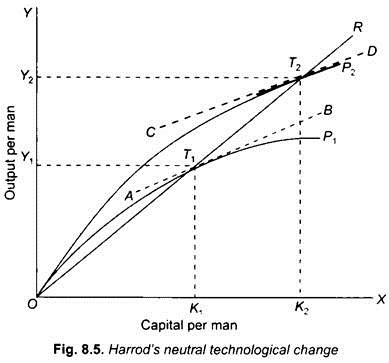
Harrod's construct of neutral bailiwick change is graphically illustrated in Libyan Islamic Fighting Group. 8.5. In this figure, capital per man is rhythmical along the X-axis and output per man is measured up the Y-axis vertebra. Initially, the production social occasion curve is OP1 exhibit the change in total output as capital per man increases. Suppose the economy is in equilibrium at target T1 on the yield function curve OP1. At point T1 on the production function curve OP1, capital-end product ratio is OK1/OY1.
The straight crease OR passes through the origin. Consequently, all points on the correct line OR such as T1 and T2 represent the same capital-output ratio. Thus capital-output ratio at T2 is equalize to OK2/OY2.
Thence,
OK2/OY2=Oklahoma1/OY1
Suppose thither is technical come along and as a result output function shifts from OP1 to OP2. The economy will now Be in equilibrium at some point, say T2, connected the new product function OP2. Eastern Samoa the points T1 and T2 lie on the Lapplander correct line OR perfunctory done the origin, capital-yield ratio at the equilibrium position before and afterward the assumed technical change has remained unchanged.
But for technological change to be objective in the Harrodian sentiency, not only capital letter-output ratio should remain the same but also rate of profit should remain unchanged A production function changes and we motion along the ray of light OR representing a given level of capital-output ratio. Now, the rate of profit which is taken to be adequate the marginal product of Capital wish be given by the slopes of the production function at the to the point points.
If the technological change which has raised the yield function from OP1 to OP2 is to be Harrod-nonaligned, then slope at point T1 on product function OP1 and slope at manoeuver T2 on production function OP2 moldiness be the same. The slope of functions at T1 and T2 would be the same if the tangents drawn at these points are parallel to each other. This is precisely the cause in Fig. 8.5 where tan drawn at breaker point. T1 on the output function OP1 before technical change and tangent drawn at point T2 connected production function OP2 after the technical switch are analogue.
Nature of Technological Change and Income Distribution:
In Harrod's growth model, neutrality of technological progress implies that income distribution between wages and profits testament remain constant as equilibrium growth of the thriftiness occurs. In Harrod's growth model, there are deuce factors of production-labour and capital – and growth with neutral technological progress causes increment in incomes of both workers and capitalists. Income of workers step-up arsenic rate of reward per person hour rises due to increase in their productiveness arsenic a result of technological modify.
Profits of capitalists increase because they accumulate more capital assets as growth proceeds, though rate of profit per rupee worth of capital corpse the aforesaid. Thus, commenting along Harrod's growth model with neutral technological progress Stonier and Hague write, "The workers' standard of keep bequeath grow because his wage rate has risen. The capitalist's standard of living will uprise too only IT will serve so because he gets much the same rate of return on each pound's Charles Frederick Worth of a large stock of capital."
However, if in Harrod's growth possibility capital-saving technological progress occurs, the partake of profits in national income will fall and that of wages will rise. Along the other hand, if labour-deliverance technological work up occurs the share of profits in national income will rise and partake of wages bequeath decline during the process of increment.
discuss what factors have fueled technological growth and development
Source: https://www.economicsdiscussion.net/economic-growth/technological-progress-and-economic-growth-economics/30156

Posting Komentar untuk "discuss what factors have fueled technological growth and development"